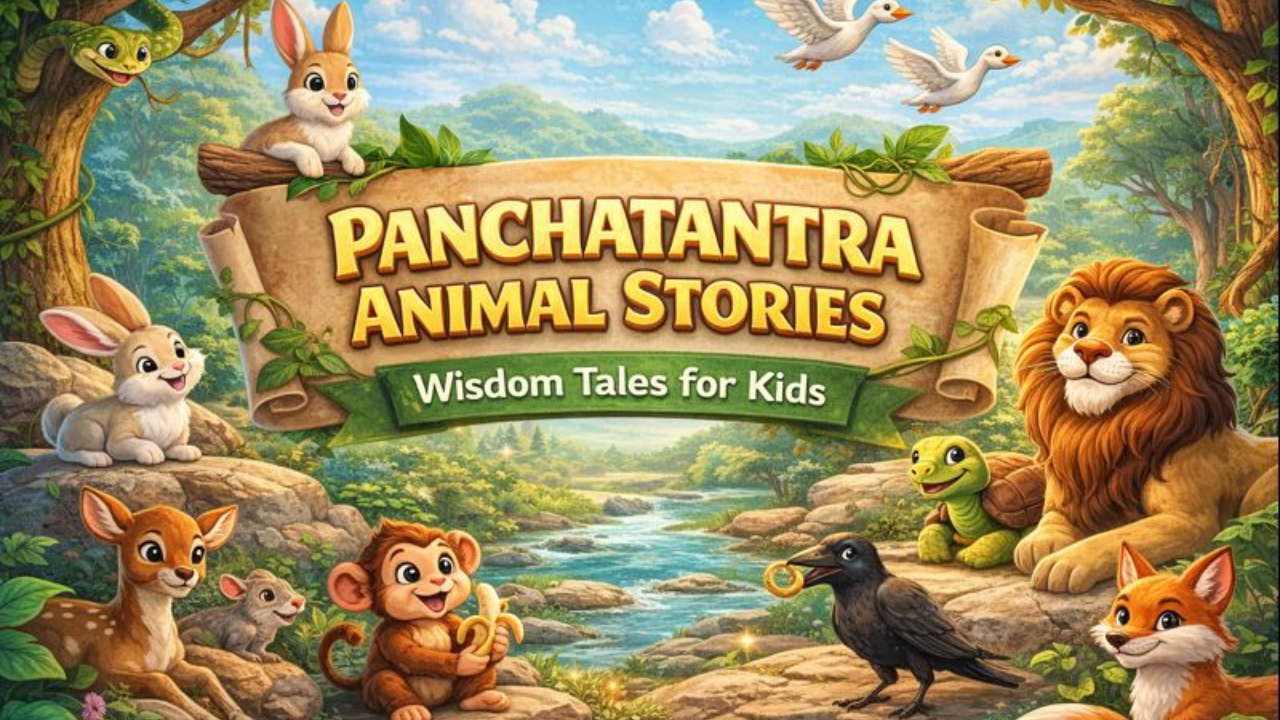
For centuries, stories have been one of the most powerful tools to teach children values, wisdom, and practical life lessons. Among the richest treasures of such storytelling is Panchatantra—a collection of animal stories that has shaped moral education not just in India, but across the world.
Panchatantra animal stories are much more than simple tales with talking animals. They are carefully crafted narratives designed to teach children (and adults) how to think, make decisions, build relationships, and navigate real-life challenges with intelligence and ethics. Even in today’s digital age, these stories remain highly relevant for kids, parents, and educators.
What Are Panchatantra Animal Stories?
Panchatantra animal stories are short moral tales where animals behave like humans—talking, planning, forming friendships, making mistakes, and learning lessons. Each story is simple on the surface but carries a deep practical message about life.
These stories were originally written to:
- Teach children wisdom and critical thinking
- Explain human behavior in an engaging way
- Prepare young minds for leadership and decision-making
Instead of direct moral preaching, Panchatantra stories teach through consequences, allowing children to naturally understand right and wrong.
Origin of Panchatantra
The Panchatantra is believed to have been written over 2,000 years ago by the scholar Vishnu Sharma. According to tradition, he created these stories to educate the three princes of a kingdom who were not interested in formal learning.
Rather than teaching them through textbooks, Vishnu Sharma used stories with animals as characters—making lessons memorable, entertaining, and easy to understand.
The word Panchatantra means “Five Treatises”, representing five interconnected sections, each focusing on a specific aspect of life such as friendship, conflict, loss, strategy, and cooperation.
Why Animals Are Used in Panchatantra Stories
One of the most unique features of Panchatantra is its use of animals instead of humans. This is done intentionally for several reasons:
1. Easy Understanding for Children
Children naturally connect with animals. A clever fox or a proud lion captures attention faster than adult characters.
2. Safe Moral Teaching
Using animals avoids direct criticism of people or society, making lessons acceptable and universal.
3. Symbolism
Each animal represents human traits:
- Lion → Power and authority
- Fox → Cleverness and cunning
- Crow → Intelligence and observation
- Monkey → Mischief and impulsiveness
- Tortoise → Patience and wisdom
This symbolism helps children recognize behaviors in real life.
Key Moral Themes in Panchatantra Animal Stories
Panchatantra stories cover a wide range of moral and life lessons, including:
- Wisdom over strength
- Importance of true friendship
- Consequences of greed
- Dangers of blind trust
- Value of patience and planning
- Power of unity and cooperation
- Importance of thinking before acting
Unlike simple “good vs bad” tales, Panchatantra stories often show complex situations, preparing children for real-world thinking.
Popular Panchatantra Animal Stories and Their Morals
🦁 The Lion and the Clever Rabbit
Story Summary:
A cruel lion terrorizes the forest. A small rabbit uses intelligence instead of strength to defeat the lion by tricking him into falling into a well.
Moral:
👉 Intelligence is more powerful than physical strength.
🐦 The Crow and the Snake
Story Summary:
A crow’s eggs are eaten by a snake. The crow cleverly steals a queen’s necklace, leading guards to the snake’s hole.
Moral:
👉 Intelligence and strategy can solve even big problems.
🐢 The Tortoise and the Geese
Story Summary:
A talkative tortoise ignores advice and speaks at the wrong moment, leading to his downfall.
Moral:
👉 Think before you speak.
🐒 The Monkey and the Crocodile
Story Summary:
A crocodile tries to betray his monkey friend, but the monkey escapes using quick thinking.
Moral:
👉 Presence of mind can save your life.
🐂 The Lion and the Bull (Mitra Bheda)
Story Summary:
A misunderstanding created by a clever jackal breaks the friendship between a lion and a bull.
Moral:
👉 Beware of false friends and rumors.
Educational Value of Panchatantra Stories for Kids
Panchatantra animal stories offer multi-dimensional learning, making them ideal for children’s development.
🧠 Improves Thinking Skills
Children learn how characters plan, analyze situations, and solve problems.
🗣️ Builds Language and Communication
Stories improve vocabulary, listening skills, and storytelling ability.
❤️ Develops Emotional Intelligence
Kids understand emotions like jealousy, fear, trust, and kindness.
🧭 Encourages Ethical Decision-Making
Children learn that actions have consequences.
Why Panchatantra Stories Are Still Relevant Today
Despite being ancient, Panchatantra animal stories remain extremely relevant in modern life.
- Children still face peer pressure, trust issues, and decision-making challenges
- Stories teach practical wisdom, not outdated morals
- Lessons apply to school life, friendships, and family situations
- Ideal alternative to excessive screen time
These stories are now widely used in:
- Schools and moral education
- Bedtime storytelling
- Children’s YouTube channels
- Animated series and audiobooks
Best Age Group for Panchatantra Animal Stories
- Ages 4–6: Simple retellings with pictures
- Ages 7–9: Short stories with clear morals
- Ages 10–12: Detailed stories with discussions on strategy and ethics
Parents and teachers can adapt the storytelling depth based on age.
How Parents Can Use Panchatantra Stories Effectively
✔️ Read one story daily as a bedtime routine
✔️ Ask children what they learned from the story
✔️ Relate the moral to real-life situations
✔️ Encourage children to retell the story in their own words
✔️ Use stories for discussion, not lecturing
Panchatantra vs Modern Moral Stories
| Aspect | Panchatantra Stories | Modern Moral Stories |
|---|---|---|
| Depth of Lessons | High | Moderate |
| Story Complexity | Strategic | Simple |
| Cultural Value | Rich heritage | Limited |
| Long-Term Impact | Strong | Short-term |
Panchatantra stories stand out for their timeless wisdom and layered storytelling.
Conclusion
Panchatantra animal stories are a priceless gift of ancient wisdom that continue to shape young minds even today. Through simple narratives, animal characters, and engaging plots, these stories teach children how to think, not what to think.
In a world filled with instant content and short attention spans, Panchatantra stories offer children something truly valuable—wisdom, patience, intelligence, and moral clarity.
Introducing Panchatantra animal stories to kids is not just about entertainment; it’s about nurturing thoughtful, ethical, and confident individuals for the future.